Taking photos using your smart phone with some adjustments is a great way to start off but you may feel that you want to go a bit further with your photos before reaching out to a professional product photographer.
Contents
Lighting Boxes
Lighting makes a big difference to photos but there is a tremendous amount that can be done with lights. In a studio there are different types of lights, many different diffusers, different colour temperatures and intensities to name some aspects. We can go a long way to simplifying this down to a home user, however, using a lighting box.
A Lighting box is like mini studios for your product photography. Typically there will be one or a few coloured inserts to use as back-drops inside the box and come with one or more lights at the top to illuminate your products.
I use a “photo shooting tent” by ESDDI: Amazon UK // Amazon US
With many cheaper lighting boxes there is a sharp corner at the back of the box, which can be seen in the photos. This box uses a curved back, which is less visible (commonly invisible) in the product shots. If you look for a different product, this is the key aspect that I recommend looking for. This box also has multiple colours, which is very useful when taking photos of products contrast well (I.e.: light product on dark background and vice-versa). This also has a dimmer knob to provide flexibility in the amount of light.
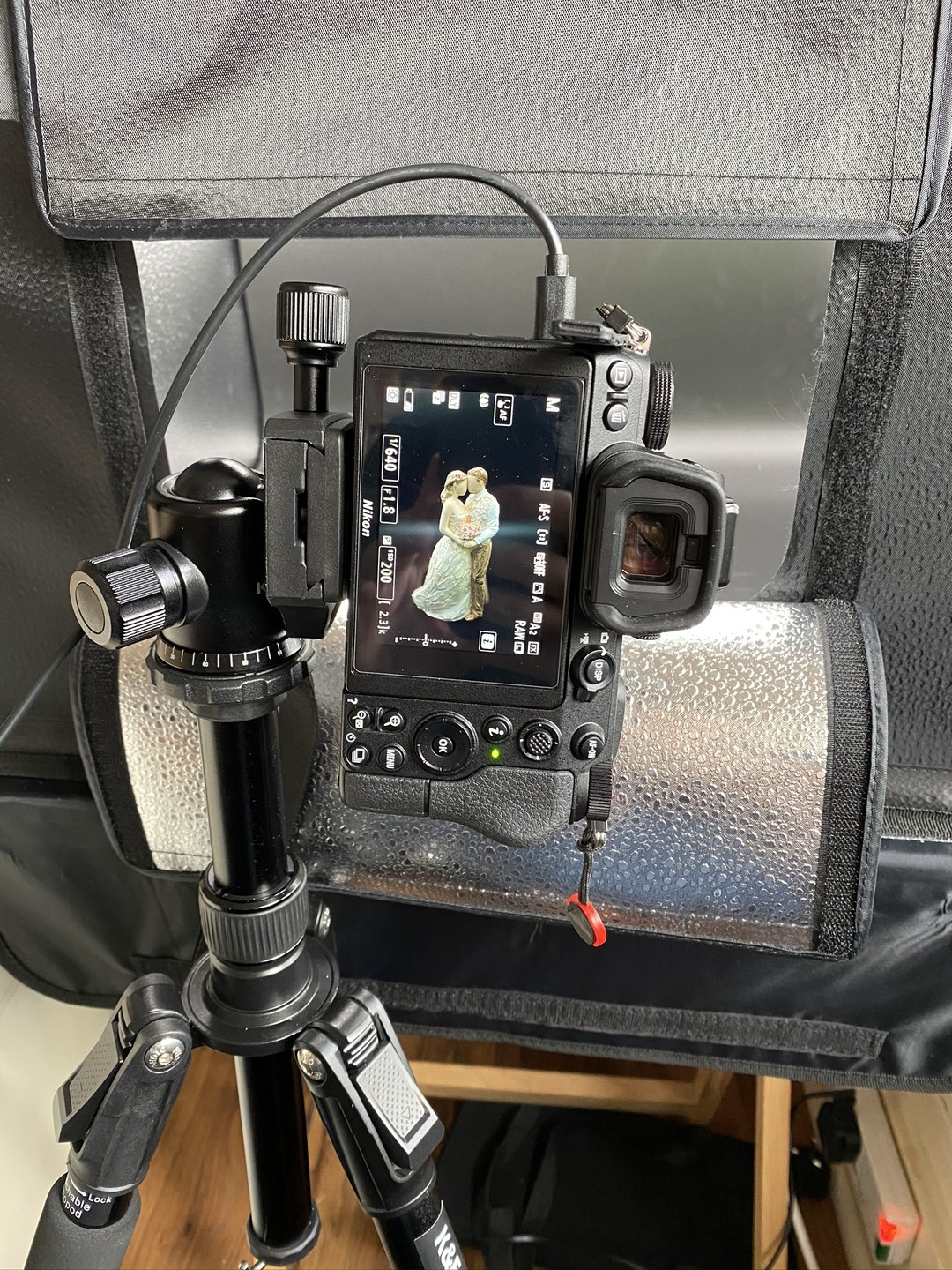
The camera, tripod and photo tent used in these examples
Camera
There are multiple options for interchangeable lens cameras. Most notably these include:
-
Micro four thirds – These are compact, interchangeable lens cameras with a small image sensor. They commonly have the smallest, lightest bodies
-
APS-C – Due to the smaller sensor size, APS-C cameras typically have a much smaller, lighter body than full frame cameras
-
Full frame – This is the type that we will focus on. More about full frame below
-
Medium format – Medium format is the type of camera used in studios by product photo specialists. They also come with a premium price tag, often 8-10 times that of a full frame camera
Full frame cameras are essentially the standard format for cameras and have the potential to provide a higher quality than APS-C or Micro 4/3 cameras due to the high dynamic range, which make them a great choice for product photography.
Some great choices:
-
Nikon D750 – An older model by Nikon but no compromise in quality. Should be able to find this at a decent price. Amazon UK // Amazon US
-
Canon EOS 6D Mark II – Great value for money from Canon Amazon UK // Amazon US
-
Nikon Z6 – One of two of Nikon’s first full-frame, mirrorless cameras. Amazon UK // Amazon US
Any full frame camera within the last 5 years should serve you well for product photos.
I used the Nikon Z7 for the DSLR photos on this site. The immediate benefit of mirrorless cameras is that they are more compact, which is not a standard factor if you only use the camera for product photography. They do use a very new storage format, XQD, which comes with a substantially higher price tag. The other cameras, above, use the widely more popular SD cards and will work fine if you have a spare micro SD card with SD adapter.
Lenses
If you do not have or are not intending to use a DSLR (interchangeable lens) camera this section can be skipped.
The lens will have more of an effect on the photos than the camera body. If you have a high-quality camera with a low-quality lens this will result in a lower quality than desired.
For versatility I would recommend a telephoto lens. These are lenses that have adjustable focal lengths, colloquially referred to as zoom. They are easily distinguishable from fixed focal length lenses by the name; telephoto lenses will have a range of focal lengths (E.g.: 18-55mm), whereas fixed focal length lenses have a single focal length in the name (E.g.: 35mm). Fixed focal length lenses excel for portrait photography as they tend to be able to have lower apertures (f/1.4) than telephoto (commonly f/2.8 being the lowest). More on aperture in a separate article but, typically, lenses with low apertures (f/4 or lower) are also high quality lenses.
Example recommended lenses:
-
Nikon cameras (other than Z6 or Z7, which uses a different mount) – Nikkor 24-120 f4 Amazon UK // Amazon US
-
Nikon Z6/Z7 – Nikkor 24-70 f4 Amazon UK // Amazon US (Also available with the camera: UK // US)
-
Canon cameras (other than EOS R, which use a different mount) – Canon 24-70 f4 Amazon UK // Amazon US
-
Other – A focal length of around 24-70 at f/4 will cater for close-up shots for a wide variety of product sizes
Tripod
A tripod is very useful to get consistency in the height of the camera compared to the subject and keep the camera steady so that there are no blurred lines due to the camera vibrating. The main thing to account for for product photography is that the tripod is rated for sufficient weight. The weights of the cameras and lenses are easily sourced online.
A Nikon D750, for example, is 840g (1lb 13.7oz) with battery and memory card and a 24-120 f4 lens is 712g (1 lb 9.12oz) so an Amazon Basics tripod (UK // US), which is rated for 3Kg (6.6lb) will ensure that the tripod does not descend with the amount of weight.
The screw at the top of the tripod is universal and will screw into the bottom of any DSLR camera.